


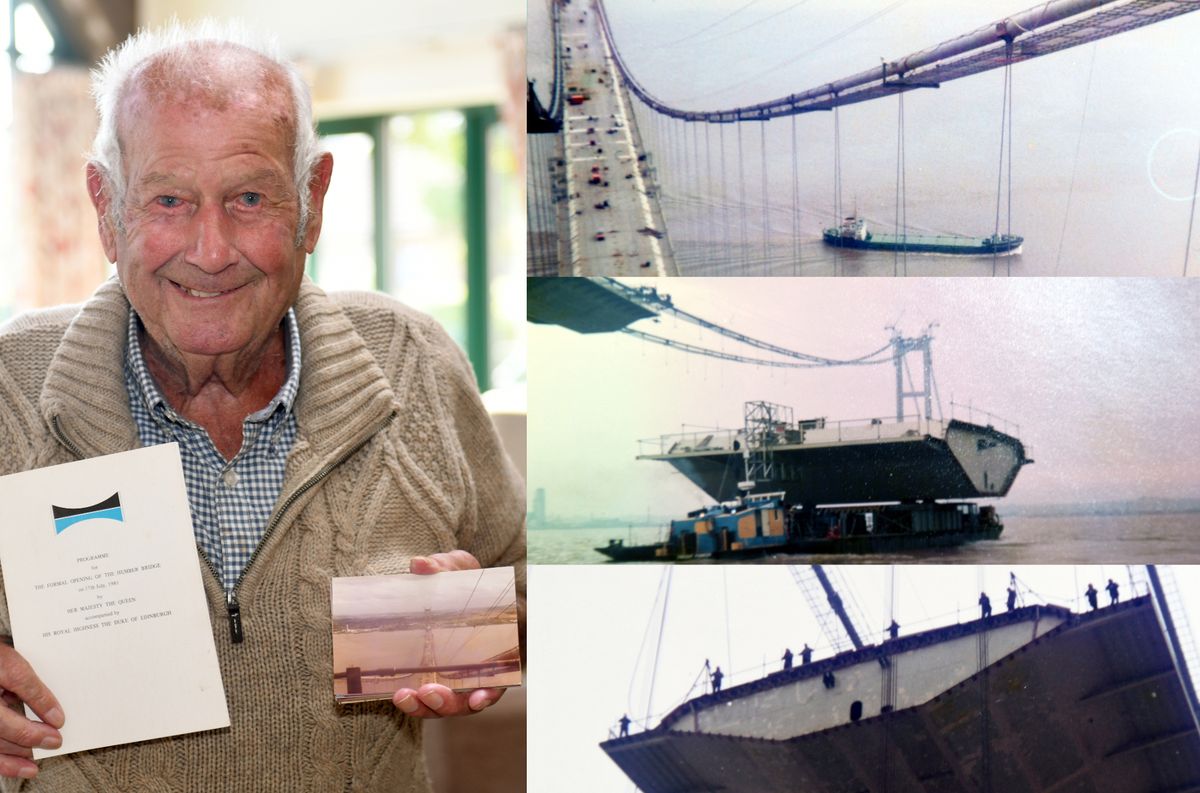
Harry Stewart recalls the hard work and ingenuity that went into building the iconic crossing
Four decades after helping shape one of Britain’s most iconic landmarks, 88-year-old Harry Stewart is looking back on the gruelling height, sharp icy winds, and unbreakable camaraderie that defined the construction of the Humber Bridge.
Harry worked on the massive structure from 1977 until its official opening in 1981, braving extreme conditions hundreds of feet above the estuary. His journey began with a sudden summons and a severe test of his nerves.
“I was on the spinning of the cable and on the box sections when they lifted those, there are 124 box sections”, he said. “I was up at the top of the tower all the time, I was frightened to start with – I started on a Friday, I got a telegram Thursday night telling me to report to Hessle Tower 5:30 Friday morning.
“I had to go up on the Alimak which is like a lift which took you to the top of the towers. I was so frightened when I first started – two pairs of socks on and I go dizzy now, it was that good a job though that I kept it. We had to wear long johns because mid span, middle of the Humber it was very cold and windy, especially during winter – we had cabins up there.
“There was a permanent night shift up there, someone was there 24 hours of the day. I ended up doing permanent afternoons so 1pm till about 9 or 10pm. They had a teaboy and that was his job to bring the flasks on his back to us at the mid span.
See more photos from Harry’s time working on the Humber Bridge in this gallery
“When I was doing the cables we had to walk alongside, it was like mesh at your feet, you could see straight through it and it use to bounce. Your legs ached when you did a lot of walking and you really felt the weather. I got over my fear of heights quickly because it was such a good job and there were so many trying to get work on there.”
The construction demanded precision engineering, constant vigilance, and meticulous care for materials exposed to the elements.
Harry said: “Every day I would get the Alimak up the towers and that was it then until you finished – then I would have to walk alongside the cables. If it was too windy we couldn’t spin the cables, the cables are only an eighth of an inch thick, we use to make screwdrivers with them, they’re all spun in together with a compacting machine.
“Alongside the cables where we walked there was a handrail, but in those days, there were no harnesses like you see now. The compacting machine ran alongside so slowly to make it round and you had to walk alongside that. When the cables were brought onto site they had to cover them over because of bird muck, acid, they had to be covered with tarpaulins.
Beyond the perilous physical conditions, it was the human side of the job – and a few daring family moments – that left the deepest impression on Harry.
He said: “I have so many good memories of working on there. Probably one of my favourites was when I took my daughter Michaela to the top of the towers. She was only 12, it wouldn’t be allowed now but it was about two years before it opened. My two sons wouldn’t do it, they stopped the Alimak and said to take them back down but, my daughter, she didn’t mind, she did it and I took her picture which is a good job because they wouldn’t believe her at school that she’d done it and been up to the top!
“I worked with some good lads but there aren’t many of us left now. The comradeship was good, sadly you just don’t get that now. Everyone looked out for each other, you had to, safety is the main thing, I always said that. I’d see young lads starting on jobs and be like ‘oh no don’t do that, it’s not safe’. I’d tell them ‘never work with your back to the machine, always face the machine cause that machine could kill you’.”
Standing high above the water offered breathtaking panoramas, leaving Harry with an enduring affection for the project. “From the top you can see for miles all around, you can easily see the coast. It’s like just looking down and the coast is right there. It was such a good job – I wish I was just starting it all over again.”
Harry took on a range of responsibilities across the site, working on both the concrete towers and the complex steel superstructure.
“I did anything they asked me to do, rigging, erecting whatever was needed”, he said. “The concrete towers had already been done when I started. The legs and crossings, they’re not solid concrete – on one side there’s a service lift and the other side ladders – 50ft, stage, another 50ft, stage, another 50ft, stage, another 50 and so on. People think they’re solid but they’re not. The cross sections are like corridors to walk across,” he explained.
Installing the heavy deck sections presented some of the most dangerous and delicate operations of the entire build, heavily dependent on the movement of the tides. “I worked on the box sections too and they moved so slowly,” Harry said. “It moved but you couldn’t see it moving. By the time it was in position the concrete had gone solid, it went that slow.
“One of my pictures shows the lifting of the box section. Each section weighed more then 120 ton each and there are 124 of them. They were tugged into place with a pusher tug from ABP who pushed them into place before they were lifted.
“You had to get them lifted right on the ebb, when the tide was right. If it was too windy and they couldn’t be lifted they had to take them back and wait for the next tide. I was on the first pontoon when they lifted the first box section off. It spun right round which was frightening. On one of the lifts they took the pressure off and it moved and twisted round. People that live round there said the sound was like an explosion going off. You can imagine the sound it would have made.”
While admiring the sheer scale of the achievement, Harry retains a nostalgic affection for the transport era the bridge replaced when ferries travelled between Hull on the North Bank and New Holland on the South. “It’s marvellous and clever engineering. For me I would have liked it to be built somewhere closer to town but it’s too big a span that’s what it was, where it was built it was not as big a span.
“I went on the last ferry – I wish they had kept the ferry going as well, I think it would have done really well. People used to love the ferry, it didn’t take many cars at a time but it was good.”
Years of hard labour culminated in a historic royal occasion, providing a proud moment that stays with Harry whenever he views the crossing today.
“I was also there when the Queen came to officially open it on July 17, 1981. It was a really good day that, we had a sit down meal afterwards too. I sometimes go past the Humber Bridge now and I proudly look and wish I was still on there, I worked with some good lads.”
The Humber Bridge was just one chapter in a remarkably varied infrastructure career for Harry, spanning major projects across the UK and Europe. He explained: “I had some good jobs, I also worked on the Channel Tunnel doing the compressed air, I worked on the Euro tunnel in France too.
“I also worked for two years on Princes Quay doing the concreting. I did work on the flood defences too, from Humber Bridge to Victoria Dock. My last job was at Siemens with the wind turbines.
“A lot of the workers were Danish, one of them came over asking for my name. I was thinking at first I had done something wrong even though I knew I hadn’t. He said tomorrow you need to go to the main Siemens office at 2pm and report to reception. When I went they took my name and sent me to this room where everyone was dressed up. I was just in my working gear wondering what was going on, next thing they are presenting me with employee of the week! I’ve had some good jobs and worked with some good people, happy memories.”
Did you know you can make Hull Live a preferred source of Hull news in Google, which will mean you get more of our breaking news, exclusives, and must-read stories straight away? Here’s more information about what this means and how to do it – you can also do it straight away by clicking here.