


Naj ModakEast Yorkshire and Lincolnshire
 Richard Jones
“Heroes” of a rail disaster that left 12 people dead and 46 injured should be remembered, an author has said.
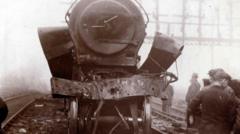
Railway workers, doctors and nurses rushed to evacuate casualties – including schoolchildren – following a head-on crash between two commuter trains outside Hull’s Paragon Station on the morning of 14 February 1927.
At one point, they broke through a wall of a neighbouring hospital to take people to safety.
Richard Jones, a Bridlington-based historian who has written a new book about the disaster, said the rescuers “stopped at nothing to extract injured survivors from the wreckage”.
The crash happened at the Argyll Street bridge, close to where Hull Royal Infirmary now stands, when an incoming train from Withernsea collided with a service leaving the station for Scarborough.
Carriages at the front of both trains were crushed, causing death and horrendous injuries.
“The plight of the passengers was pitiable,” a reporter from the Hull Daily Mail wrote at the time. “Owing to the manner in which the coaches have been literally squashed together, the rescuers experienced the utmost difficulty in extricating the injured and the killed.”
Within a few minutes, railway workers armed with hammers, saws and axes began trying to release trapped passengers, while doctors and nurses “scaled the wall” from the neighbouring hospital.
 Getty Images
One casualty was seen “working heroically… holding up a piece of the wreckage” while one of his legs “was being bandaged to staunch the blood”. He “steadfastly refused to leave his task”.
Another, the fireman of the Withernsea train, was praised for “plunging into the work of rescuing the dead and injured” despite “bleeding profusely from the face”, the Mail reporter wrote.
Lines of wounded were laid out on cushions and stretchers on the track side. The dead were covered with blankets.
Mr Jones said it was East Yorkshire’s worst rail crash, but many of the names of those who took part in the rescue were never recorded.
Earlier the year, a plaque was unveiled at Paragon Station to commemorate the disaster.
The author helped organise the tribute after previous plaques were lost.
 Richard Jones
It was unveiled by Richard Kitching, the grandson of one of the victims, Percival Kitching.
He said his father, who usually sat at the front of the train, had a lucky escape.
“On this particular day, my father asked if he could go sit with his pals at the back of the train. My grandfather said that was absolutely fine, so he did and that ultimately saved his life.”
An inquiry into the disaster concluded that it was caused by human error, when a signalman inadvertently diverted the Scarborough train in to the path of the oncoming Withernsea engine.
Mr Jones’s new book, called Paragon ’27 – The Hull Rail Disaster, tells the story of the crash and those caught up in it.
“This has been a fascinating journey into a slice of Hull and railway history that has never before had the story properly told,” he said.
“A lot of people didn’t even know this had happened. It’s still very much forgotten about.”
He said he hoped the new book, which will be available on 3 November, would help shed light on the story, “on behalf of the people who lost somebody in this disaster”.