


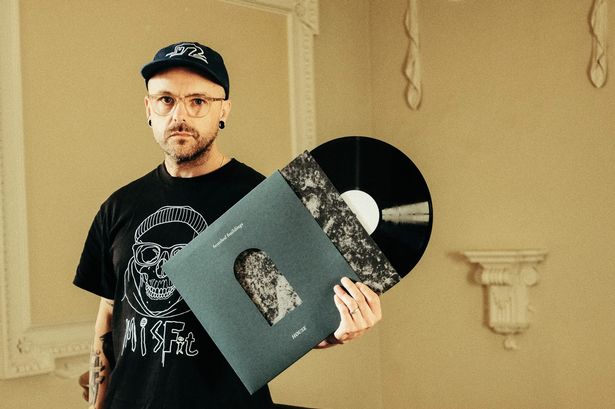
Stewart Baxter has taken inspiration from the devastating bombing of Hull in the Second World War for his latest composition
An improvised performance by Hull musician Stewart Baxter is being committed to vinyl with the help of equipment used in the Nuremberg Trials. “Bombed Buildings – House” is inspired partly by the bombing of Hull in the Second World War.
Stewart, who is the drummer in city indie band LIFE, says he began to explore ambient music when the band were forced off the road during the pandemic. He picked up commissions from Freedom Festival and Absolutely Cultured in Hull – which led him to set up a studio in the historic Maister House with the help of Eclectic Music founder Danny Thompson who has helped steer the Grade I listed building as a hub for creatives.
The Bombed Buildings records – each unique thanks to contributions from other musicians – have been cut at Leeds-based Rare Tone Mastering where engineer Ben Pike uses a Presto 28N dual lathe which was used to record the Nuremberg Trials more than 80 years ago. Ben bought the kit after it had been brought to the UK ten years before, having emerged in the 1960s.
Stewart, 45, said: “In the Second World War, Hull was the most bombed city outside London. Working with Ben was remarkable for the link between his equipment and the war, and for the way we were able to produce unique recordings.”
He heard about the impact of the Luftwaffe’s campaign on Hull, particularly in the Hessle Road area. Stewart added: “When houses were demolished as part of the regeneration we nicknamed them ‘Bombed Buildings’. I have so many memories of playing in them. It was such a big part of my childhood and I can still smell the brick dust.”
Keen to create music that matched his Maister House home, Stewart worked with Dr Mark Slater, a composer, producer and musicologist at the University of Hull. The pair went on to secure funding from Help Musicians UK and Hull City Arts to develop the Bombed Buildings project.
Stewart, who is also the founder of business Hinterland Creative, said: “We started experimenting in the main stairwell and on the first landing – jamming some ambient cassette tape loop and guitar and putting mics in the stairwell. Being here really made me think about how space makes such a difference to an improvised performance. It inspired me to want to capture that, and when we listened back to the recording there was a 12-minute track that was perfect from start to finish.”
The piece was expertly handled by Ben at Rare Tone Mastering. His Presto 28N is believed to be the last working machine of its kind in the world, having originally been created by New York firm Presto Recording Corporation and shipped to Germany at the end of WW2 by US forces.
Afterwards it is believed the lathe went to Radio Free Europe, before being dismantled for storage in Germany and then Switzerland. A contact of Ben’s in Manchester drove to Switzerland in a Transit van to collect it. Ben helped to rebuild it, and then bought it.
Meanwhile, Josh Williams at manufacturer G F Smith – founded as a paper merchants in Hull in 1885 – prompted the idea of hand-making some vinyl records for the project. G F created the sleeve and design and screen printing was done by Makerspace at Hull Central Library and by local firm Misc Print Co.
Each record is made unique by the fact Stewart sent the recording to 20 people around the world, including writers, poets and friends. Each recorded a voice note in response to the piece with contributors including French musician and actor Jehnny Beth, Kate Stables of This is the Kit and rap musician Chiedu Oraka, aka the Black Yorkshireman.
Stewart said: “You will be the only person in the world with that record – it’s the opposite of Spotify and music for the masses, where you are always chasing numbers and streams.”
Copies of the records and accompanying digital downloads will be sold at a launch performance at Maister House on Tuesday, October 7, as part of the Unthinkable Film Festival. The event will feature a documentary made by James Cooper, a young film maker based in Maister House, of the creation of everything from the first recording to the final print.
Stewart explained: “The music will be me with the quartet and some special guests. It won’t sound the same as the record because it’s all improvised, so we will do a rendition. The sleeve is inspired by the building and will include unique polaroid photographs of the building.
“It’s capturing my time here in a record and involving all these people. Afterwards I’ll be looking for the next opportunity, another interesting space. It has to be site specific.”
Ben plans to be among the audience. He said: “I really liked the music and the concept. It’s always nice to work on something that’s a bit different from a standard three and a half minute song. Stewart explained the whole thing about the building he is in and how it had informed the performance. It just seems the right fit to do it on this vintage machine when it has so much history itself.”
Stewart added: “Letting this project unfold naturally gave it space to find its own path. From the music to the mix, the artwork to the vinyl pressing, everyone left their mark and took it where they wanted to take it. There’s something wild and exhilarating about making music and art this way, instead of just pressing ‘upload’ on a digital file and calling it done.
“I never went to university or had any formal education. I always had to make something from nothing. Everything I have done has been self-taught. I have had to work it out and Bombed Buildings was an extension of that. From the rubble, you can create beautiful things. You can crush everything down. You can take everything away from me and I will still make stuff.
“It’s dragged up some dark stuff for me. It felt like a purge, almost a brutal therapy session. Months later, I finally listened back and realised how raw and honest it was. It seemed to fall into three movements, like a soundtrack to some of the hardest moments of my life, including my family being made homeless as a kid. The irony of unpacking all that in a grand Georgian mansion wasn’t lost on me.”