


Natalie Glanvillin Hull
 BBC
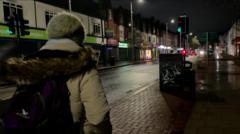
BBCIt is a cold night in November on one of Hull’s poorest streets. It has been raining and it is damp, dark and chilly in a biting breeze. Street lamps illuminate the footpaths and reflect off the puddles. A florescent glare comes from the odd takeaway.
I’m here on Hessle Road to meet support workers from ReNew, a drug and alcohol service. We will be spending the next two hours walking up and down the street to try to get a better picture of how many women are sleeping rough.
These women are known as the “hidden homeless” and are often missed on official counts because they do not stay in one spot for very long.
Many refuse to bed down for the night. They are too afraid to get in a sleeping bag and find a doorway and are often fearful of shelters.
Instead, they walk the streets to keep warm and safe. It makes them less visible and less likely to get support.
I am introduced to one woman who was homeless earlier this year, but has now been supported into a shelter.
She asked us not to use her name, but told us why she remained hidden on the streets.
“It’s scary, you are on your own. The people around you are not the kind of people you need around you,” she says.
“In order to get help, you have to be seen to be homeless, which is also quite hard because you don’t want to be seen, you know?
“The whole point of it is to find somewhere that is as safe as you can and just stay there. You don’t want people to know it’s you, you want to be anonymous.”
It is the first time a journalist has been out with workers from ReNew’s “Switch” team, who have been conducting weekly patrols in the Hessle Road area for the past six months.

The workers tell me they are concerned that women are putting themselves in danger by pacing the streets at night in an attempt to feel safe.
“They might spend time in a McDonald’s that’s open 24 hours a day, or gyms, bus stations, places like that – places with cameras so that they feel safer,” says Karla Tock, the Switch team leader.
“But then often they may hide in more plain sight – underpasses, bushes.
“Women don’t stay in the same places like men do.”
We are half an hour into our patrol when we see a woman sitting on a bollard on the corner of a street. She waves to the support workers, who are wearing lanyards and carrying backpacks filled with goodies, but she does not want anything and scurries away.
The team recognise her and say getting a wave is progress.
“We have gloves, hat, scarves,” Karla says. “We take out needle provisions for anyone who is using substances.”
They give out condoms and naloxone, which is a medication for overdose prevention, as well as hand warmers and snacks, “because we don’t know when these ladies will have last eaten”.
After four laps of the street, two women approach us.
They seem comfortable around us, though they do not want to be filmed.
One asks for a hot chocolate and a support worker, Tina, produces a paper cup and flask from her backpack.
The second woman picks up some snacks and chats for a while before rushing off in the other direction.

I stop to look at a mural of the Headscarf Revolutionaries, the group of Hull women who launched a campaign to improve safety on trawlers following a series of tragedies in the 1960s. It is a warm reminder of the sense of community in this area, which was once at the heart of the fishing industry.
Walking ahead of me is Kirsty Oldfield, another member of the Switch team. She spots a familiar face and tells me it is a woman she has been trying to help get off the streets.
Kirsty has a quick conversation with the woman, who walks off alone down a dark side street, folding her arms, her shoulders shrugged. She looks cold.
A little later on, we meet the woman’s son. He has been out looking for his mum, afraid that she had come to harm. He borrows Kirsty’s phone to call her.
Karla tells me: “It’s just about being consistent, building that rapport with women.
“You’re talking about women with multiple unmet needs who may have a real distrust in everybody around them, so it’s about building that trust with them for however long that takes.
“We’re not in no rush.”
Recently, the support workers were involved in the Women’s Rough Sleeping Census, which has been conducted every year since 2022. The initiative, which is led by a number of charities, aims to obtain more accurate data about how many women are sleeping rough.
In 2024, a total of 1,014 women, all of whom had slept rough over the previous three months, took part in the census nationwide, including 21 in Hull.
‘Need to change’
According to research from the charities Solace and Single Homeless Project, the number of women sleeping rough is more than 10 times the figure identified in government reports.
“We need to change the way that we verify a woman as rough sleeping,” says Karla.
“What is classed as rough sleeping is bedded down on the floor in a doorway, which is what we don’t see women doing.”
She wants the government to change the way people are verified, “so that we can support them and get them indoors, so they don’t feel like they need to be hidden”.
We put the concerns to the Ministry of Housing, Communities and Local Government.
A spokesperson said: “We recognise that women sleeping rough have different experiences and needs to men.
“That’s why we’ve provided more than £1bn for crucial services this year so councils can support people experiencing homelessness faster, alongside improving our data so we can target women more effectively.”
After two hours walking Hessle Road, we decide to call it a night. It’s job done for the team because one of the homeless women has agreed to pop into their offices tomorrow to try to find shelter.
Next week, they will do it all again, because, as Karla tells me: “If we speak to one woman, it’s more than not being out at all would do.”
If you have been affected by any of the issues raised in this article, advice is available from the BBC Action Line site.