


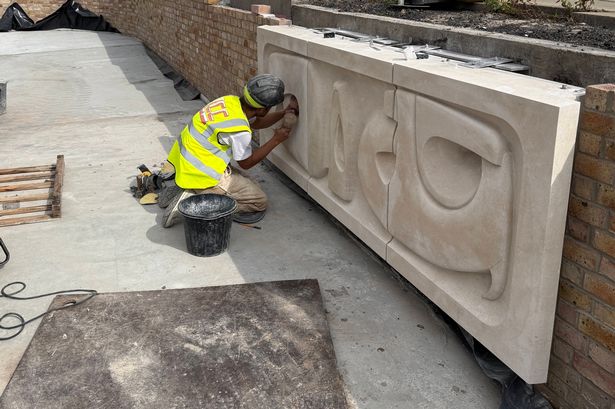
A newly-carved stone relief panel has been installed, completing a historic series of artworks originally commissioned in 1961
A new stone relief panel has been fitted in Queen’s Gardens honouring a renowned Hull artist. It completes a historic series of artworks originally commissioned in 1961.
The panel, a replica of a lost piece by the late Hull School of Art tutor Kenneth Carter, has been painstakingly reproduced by a skilled stonemason from LCC Restorations. Created from Stonehills Whitbed Portland Limestone, the panel took five weeks to finish using traditional carving techniques. Measuring roughly one metre by three metres, it now sits alongside two original panels on the eastern boundary wall near Wilberforce Drive.
The restoration was ordered as part of the ongoing revamp of Queen’s Gardens. The missing panel is one of six sculptural reliefs originally designed by Mr Carter as part of Sir Frederick Gibberd’s 1961 Masterplan for the Gardens.
Until now, only five of the six panels remained in place. Mr Carter envisaged these panels as abstract representations inspired by oceanic forms – pebbles, shells, and marine bony structures, drawing on Hull’s maritime history, as Queen’s Gardens once stood as the largest dock in the UK, then known as Queen’s Dock.
His concept was rooted in imagination; he believed that the abstract shapes, reminiscent of sea creatures and natural formations, would evoke a sense of wonder and organic beauty, transcending literal interpretation. The master carver at LCC Restoration connected with Mr Carter’s sons through genealogical research and correspondence. They shared valuable insights that guided the recreation process to ensure authenticity.
Based on a thorough examination of historical photographs and articles that were discovered and were generously provided by Mr Carter’s family, detailed sketches of the panels were produced. Full-scale templates were developed, enabling accurate transfer onto the stone.
To pay tribute to the original craftsmanship, the reliefs were painstakingly carved using traditional tools reminiscent of the 1960s, including hand chisels and grinders, replicating the techniques likely employed by Mr Carter himself, perfecting each surface with sanding and polishing techniques using specialised stones.
The final sealing preserved the intricate details, resulting in a magnificent replica that reflects the original vision. “It’s been a privilege to recreate Kenneth Carter’s work,” said the stonemason from LCC Restorations who led the carving.
“Using traditional tools and techniques to bring this panel to life has been a rewarding challenge. It’s an honour to contribute to the legacy of Queen’s Gardens and help restore a piece of Hull’s artistic heritage.”
Councillor Mike Ross, leader of Hull City Council, said: “This frieze panels hold a special place in the hearts of Hull’s residents. This careful recreation is a journey of respect and craftsmanship that honours Carter’s legacy and restores the integrity of the original artistic vision for Queen’s Gardens.
“It’s vital that we balance its historical significance with the need for modern improvements.”
The remaining five panels were also cleaned and restored. Damaged sections of the stone were repaired using a lime-based mortar mixture sourced from the original quarry where the stone was first extracted.
This mortar was specially formulated to closely match the colour and weathering properties of Portland stone. It was carefully applied to the damaged areas, with the stonemason expertly sculpting the mortar to seamlessly fill the broken fragments and merge with the surrounding surface, making the repairs virtually invisible.
All the Portland stone was cleaned using the superheated DOFF system, a gentle yet highly effective technique that uses high-temperature steam to remove dirt, biological growth, and pollutants without harming the stone’s surface. This sensitive cleaning approach ensures the preservation of the stone’s integrity and original appearance.
The improvements to Queen’s Gardens are set to be completed by spring 2026.